Basics of video lighting
Introduction
You have probably heard the title “Lighting Cameraman”. This reflects the importance of lighting in camera work. Lighting the scene is a good half of the skill of cinematography.
The simple rule is ...
cameras need a lot of light to produce good pictures, much more than you’d think.
Don’t even consider shooting interior scenes without some form of additional artificial lighting unless you subject is lit by bright sunlight from a nearby window or you are intentionally seeking a dull and indistinct look. Using light effectively is an art.
Lighting options
When lighting a scene you have 4 basic options ...
USE EXISTING LIGHT
Use the existing light and move your subject and/or camera until you get an acceptable picture.


IMPROVE EXISTING LIGHT
Improve the existing lighting by removing lampshades and fitting higher wattage bulbs.

AUGMENT EXISTING LIGHT
Augmenting the existing lighting with extra lights and reflectors.

ARTIFICIAL LIGHT
Light the scene entirely with your own portable artificial light sources.

Light characteristics
These are the primary characteristics of light ...
-
Brightness, or intensity.
-
Quality - is it Hard and shadow inducing or Soft and diffuse.
-
Contrast - the relative brightness between the lightest and darkest areas in the frame.
-
Direction.
-
Colour.
3 point lighting
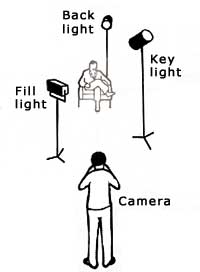
This is a popular and practical way to achieve good overall balanced lighting for interior shots involving 3 primary lighting directions ...
-
Key Light This is a hard light spotlight, usually placed above and slightly to one side of the camera pointing at the subject to reveal shape and surface detail.
-
Fill Light (filler) This is a diffuse soft light source illuminating the shadows cast by the key light, usually placed on the opposite side of the camera from the key light.
-
Back light this light illuminates the outline of the subject from behind, usually placed behind the subject and offset from dead centre by perhaps 20 degree